
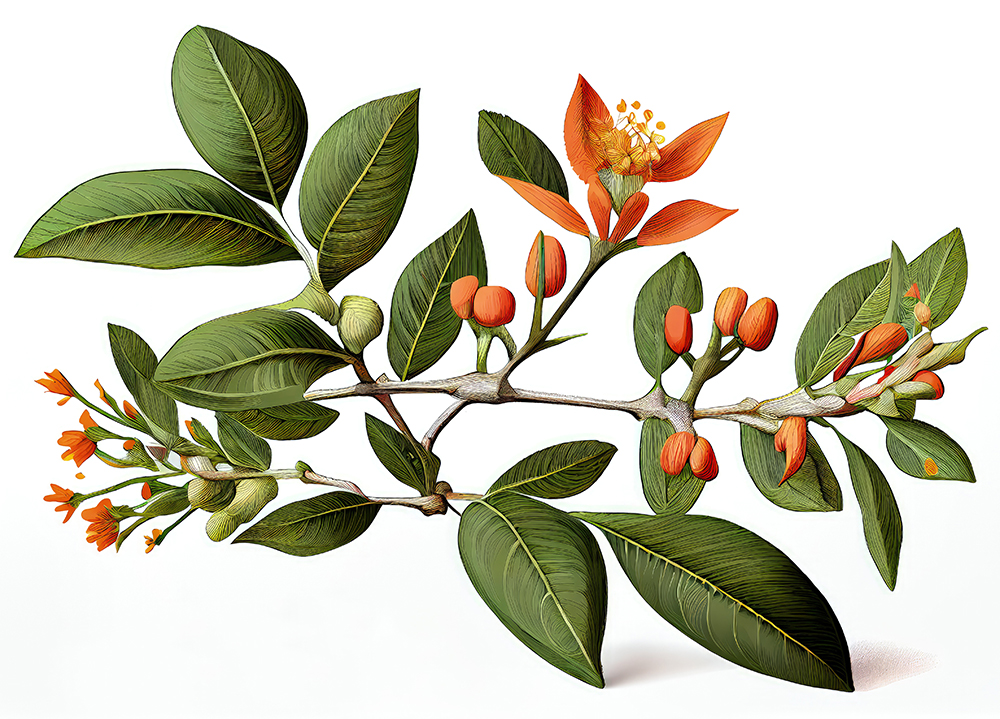
Withania
Withania somnifera is an evergreen shrub in the Solanaceae family, native to the Middle East, North Africa, other African regions, southern Europe, and the Indian subcontinent. Highly regarded in Ayurvedic medicine, Withania has been extensively researched in clinical studies, demonstrating benefits in areas such as stress reduction, fertility problems, anxiety, metabolic disorders such as dyslipidaemia, insulin resistance and diabetes, cognitive function, and obsessive-compulsive disorders.
There is growing interest in herbal therapies for mental health and neurological disorders, which are significant global public health issues, affecting more than 100 billion individuals worldwide. Conventional pharmacological treatments of these disorders may offer some symptom relief, but are expensive, have limited efficacy, and are associated with multiple side effects.1 As a result, there has been increased interest in the use of herbal therapies for treating and managing mental health and neurological disorders.
A growing body of research demonstrates the beneficial effects of Withania and its biological constituents in a wide range of mood and neurological disorders. Withania’s neuroprotective action is largely attributed to its antioxidant effects.
Withania Somnifera – a medicinal adaptogen
Commonly known as Ashwaganda, Withania (Withania somnifera) is one such medicinal plant that is being investigated as a potential neuroprotective agent. Withania is the most extensively researched adaptogen. In clinical and pharmacological studies, Withania has demonstrated multiple actions, including adaptogenic, antioxidant, cognitive-enhancing, antidepressant, anxiolytic, cardioprotective, thyroid-modulating, anti-inflammatory, immunomodulating, and neuroprotective effects.¹ Withania is highly regarded in Ayurvedic medicine, acting as an adaptogen, rejuvenating the nervous system, and enhancing the body’s resilience to stress.2
Withania’s potential in brain-related disorders
Withania has garnered interest over the last three decades due to its potential in addressing brain-related disorders. A recent systematic review published in the Journal of Ethnopharmacology evaluates the literature pertaining to the role of Withania in neurological disorders.³ In vitro and in vivo studies demonstrate positive effects of Withania and its active constituents in a wide range of neurological conditions, including stress, Parkinson’s disease, Huntington’s disease, Alzheimer’s disease, anxiety, schizophrenia, depression, bipolar disorder and attention deficit hyperactivity disorder (ADHD).³ While human clinical trials are lacking, there is some clinical evidence to support the use of Withania extracts for anxiety,4 depression,5 cognitive impairment,6 schizophrenia,7 and bipolar disorder.7
The neuroprotective activity of Withania
Withania’s neuroprotective activity is largely attributed to its antioxidant effects. It has been shown to modulate the brain oxidative stress markers, such as superoxide dismutase (SOD), catalase, lipid peroxidation (LPO), and non-enzymatic antioxidants like glutathione (GSH).8,9 The roots and their extract induce axon and dendrite outgrowth, proposing their possible effect on neuronal regeneration.10 Withania has also been shown to bind to GABA receptors, thereby acting as a GABA mimetic agent, which may explain its anxiolytic and mood-stabilising properties. Other mechanisms considered responsible for the protective effect of Withania in various CNS disorders include inhibiting acetylcholinesterase activity, increasing acetylcholine receptor expression (anti-Alzheimer’s and cognition-enhancing), and dopamine receptor expression (Parkinson’s disease).³
Looking forward
While the preclinical evidence for Withania as a neuroprotective and therapeutic strategy for CNS disorders is promising, further human clinical studies are needed to fully elucidate mechanisms of action and clinical efficacy, including optimal dosage range.
Keen to learn more?
If you would like to learn more about Withania’s potential as a medicinal plant, book an appointment today with our naturopath, Angela! You can contact All Naturopath on 0402 926 675 and via our contact form.
References:
- Chandrasekhar, K., Kapoor, J., & Anishetty, S. (2012). A prospective, randomized double-blind, placebo-controlled study of safety and efficacy of a high-concentration full-spectrum extract of ashwagandha root in reducing stress and anxiety in adults. Indian journal of psychological medicine, 34(3), 255.
- Forman, M., & Kerna, N.A. (2018). Merging Ayurvedic Ashwagandha with Traditional Chinese Medicine Part 1. Foundation in Ashwagandha: Physiological Effects, Clinical Efficacy, and Properties. Current Research in Complementary & Alternative Medicine.
- Zahiruddin, S., Basist, P., Parveen, A., Parveen, R., Khan, W., Gaurav, & Ahmad, S. (2020). Ashwagandha in brain disorders: A review of recent developments. Journal of Ethnopharmacology, 257(September 2019), 112876. https://doi.org/10.1016/j.jep.2020.112876
- Fuladi, S., Emami, S. A., Mohammadpour, A. H., Karimani, A., Manteghi, A. A., & Sahebkar, A. (2020). Assessment of Withania somnifera root extract efficacy in patients with generalized anxiety disorder: A randomized double-blind placebo-controlled trial. Current Clinical Pharmacology.
- Gannon, J. M., Brar, J., Rai, A., & Chengappa, K. N. R. (2019). Effects of a standardized extract of Withania somnifera (Ashwagandha) on depression and anxiety symptoms in persons with schizophrenia participating in a randomized, placebo-controlled clinical trial. Annals of clinical psychiatry: official journal of the American Academy of Clinical Psychiatrists, 31(2), 123-129.
- Choudhary, D., Bhattacharyya, S., & Bose, S. (2017). Efficacy and safety of Ashwagandha (Withania somnifera (L.) Dunal) root extract in improving memory and cognitive functions. Journal of Dietary Supplements, 14(6), 599-612.
- Chengappa, K.R., Bowie, C.R., Schlicht, P.J., Fleet, D., Brar, J.S., Jindal, R., 2013. Randomized placebo-controlled adjunctive study of an extract of Withania somnifera for cognitive dysfunction in bipolar disorder. J. Clin. Psychiatr. 74 (11), 1076–1083.
- Gupta, S.K., Dua, A., Vohra, B.P., 2003. Withania somnifera (Ashwagandha) attenuates antioxidant defense in aged spinal cord and inhibits copper induced lipid peroxida-tion and protein oxidative modifications. Drug Metabol. Drug Interact. 19 (3), 211–222.
- Prakash, J., Yadav, S.K., Chouhan, S., Singh, S.P., 2013. Neuroprotective role of Withania somnifera root extract in Maneb-Paraquat induced mouse model of Parkinsonism. Neurochem. Res. 38 (5), 972–980.
- Durg, S., Dhadde, S.B., Vandal, R., Shivakumar, B.S., Charan, C.S., 2015. Withania somnifera (Ashwagandha) in neurobehavioural disorders induced by brain oxidative stress in rodents: a systematic review and meta‐analysis. J. Pharm. Pharmacol. 67 (7), 879–899.
